
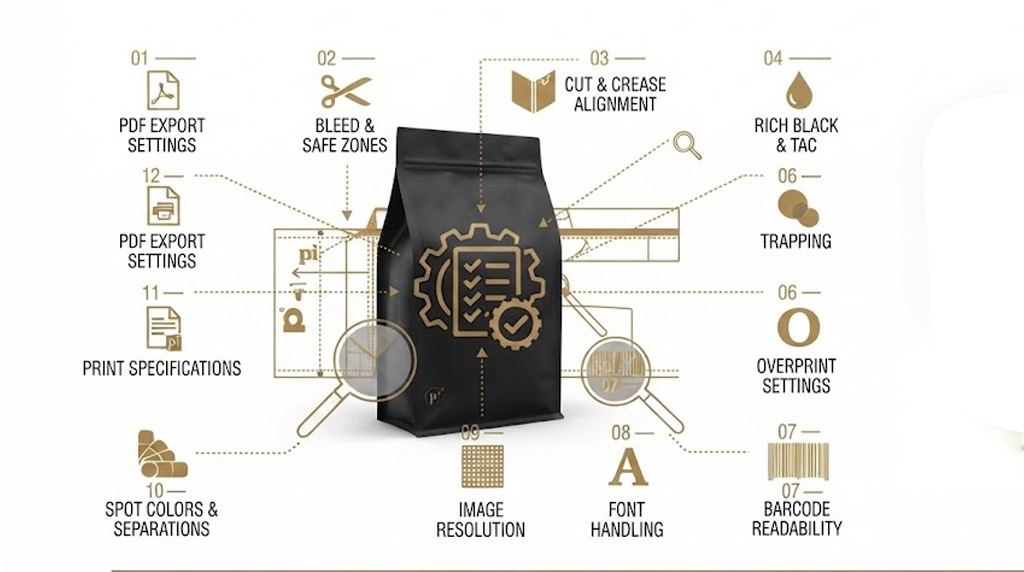
12 Technical Checks I Perform Before Approving Packaging Artwork for Production
A packaging file isn’t production-ready just because everyone has approved the design.
Before a coffee bag goes to print, I don’t ask whether it looks beautiful.
I look for the technical details that determine whether it can actually be manufactured accurately, consistently, and without costly surprises.
Every packaging file goes through a structured prepress audit before I consider it ready for production.
The 12 Technical Checks I Perform
01 — Dieline Accuracy
I verify that the dieline is correct, complete, and aligned with the intended package structure.
02 — Bleed & Safe Zones
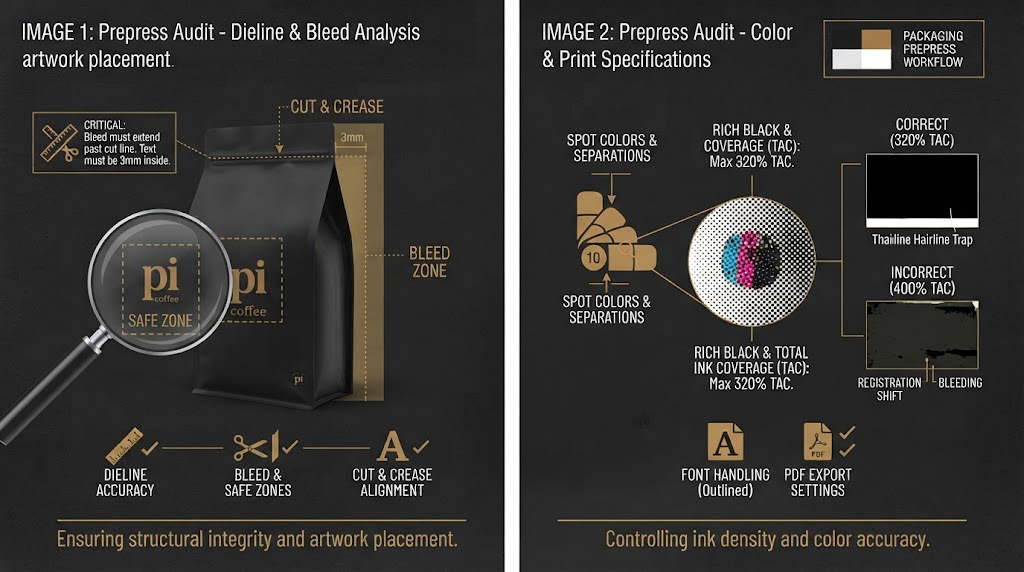
I check that artwork extends beyond cut lines where required and that critical information remains safely away from cuts, folds, seals, and other vulnerable areas.
03 — Cut & Crease Alignment
Cut and crease lines must accurately reflect the physical construction of the package and remain properly aligned with the artwork.
04 — Rich Black & Total Ink Coverage (TAC)
I check black builds and total ink coverage to reduce the risk of excessive ink deposition, drying issues, set-off, or other production problems.
05 — Trapping
I review trapping between adjacent colors to minimize registration-related gaps and unwanted white edges during printing.
06 — Overprint Settings
Incorrect overprint settings can cause elements to disappear, change appearance, or print differently from what was intended.
07 — Barcode Readability
Barcodes must meet the required technical specifications and maintain sufficient contrast, size, and clear space for reliable scanning.
08 — Font Handling
I verify that fonts are correctly embedded or outlined where appropriate, preventing font substitution and unexpected changes during production.
09 — Image Resolution
Images are checked for sufficient effective resolution at their final output size, especially when artwork contains detailed photography or graphics.
10 — Spot Colors & Color Separations
I verify spot colors, CMYK separations, and special channels to ensure that the intended printing process is accurately represented in the final artwork.
11 — Print Specifications
The artwork must match the actual production requirements, including substrate, printing process, dimensions, finishing, and other supplier specifications.
12 — PDF Export Settings
Finally, I verify that the exported production PDF preserves the technical information required by the printer — including color spaces, separations, bleed, overprint, transparency, and other relevant settings.
Small Details. Expensive Consequences.
Each of these checks may seem like a small technical detail.
In production, they aren’t.
A missing bleed can create unwanted white edges.
An incorrect overprint setting can make critical information disappear.
Poor ink coverage can create production difficulties.
An incorrect color separation can introduce unexpected colors or additional printing requirements.
An unreadable barcode can prevent products from being properly scanned at retail.
These aren’t design problems.
They’re production problems caused by artwork that wasn’t technically prepared for production.
Why a Prepress Audit Matters
Most production problems don’t begin on the printing press.
They begin long before production starts — in the artwork, the PDF, the color setup, the dieline, or the technical specifications.
That’s why a professional prepress review is one of the most valuable steps before approving packaging artwork for production.
The goal isn’t simply to find mistakes.
It’s to identify production risks while they are still inexpensive to fix.
Design approval is the end of the creative process.
Prepress approval is the beginning of successful production.
For coffee and tea brands, the difference can mean avoiding costly corrections, delays, reprints, and inconsistencies after the artwork has already reached the factory.
**Production-ready packaging isn’t just approved artwork.
It’s artwork that has been technically prepared for the realities of manufacturing.**
CTA
If you could only check one thing before approving packaging artwork for production, what would it be?
I’d love to hear your answer in the comments.
12 Technical Checks I Perform Before Approving Packaging Artwork for Production
A packaging file isn’t production-ready just because everyone has approved the design.
Before a coffee bag goes to print, I don’t ask whether it looks beautiful.
I look for the technical details that determine whether it can actually be manufactured accurately, consistently, and without costly surprises.
Every packaging file goes through a structured prepress audit before I consider it ready for production.
The 12 Technical Checks I Perform
01 — Dieline Accuracy
I verify that the dieline is correct, complete, and aligned with the intended package structure.
02 — Bleed & Safe Zones
I check that artwork extends beyond cut lines where required and that critical information remains safely away from cuts, folds, seals, and other vulnerable areas.
03 — Cut & Crease Alignment
Cut and crease lines must accurately reflect the physical construction of the package and remain properly aligned with the artwork.
04 — Rich Black & Total Ink Coverage (TAC)
I check black builds and total ink coverage to reduce the risk of excessive ink deposition, drying issues, set-off, or other production problems.
05 — Trapping
I review trapping between adjacent colors to minimize registration-related gaps and unwanted white edges during printing.
06 — Overprint Settings
Incorrect overprint settings can cause elements to disappear, change appearance, or print differently from what was intended.
07 — Barcode Readability
Barcodes must meet the required technical specifications and maintain sufficient contrast, size, and clear space for reliable scanning.
08 — Font Handling
I verify that fonts are correctly embedded or outlined where appropriate, preventing font substitution and unexpected changes during production.
09 — Image Resolution
Images are checked for sufficient effective resolution at their final output size, especially when artwork contains detailed photography or graphics.
10 — Spot Colors & Color Separations
I verify spot colors, CMYK separations, and special channels to ensure that the intended printing process is accurately represented in the final artwork.
11 — Print Specifications
The artwork must match the actual production requirements, including substrate, printing process, dimensions, finishing, and other supplier specifications.
12 — PDF Export Settings
Finally, I verify that the exported production PDF preserves the technical information required by the printer — including color spaces, separations, bleed, overprint, transparency, and other relevant settings.
Small Details. Expensive Consequences.
Each of these checks may seem like a small technical detail.
In production, they aren’t.
A missing bleed can create unwanted white edges.
An incorrect overprint setting can make critical information disappear.
Poor ink coverage can create production difficulties.
An incorrect color separation can introduce unexpected colors or additional printing requirements.
An unreadable barcode can prevent products from being properly scanned at retail.
These aren’t design problems.
They’re production problems caused by artwork that wasn’t technically prepared for production.
Why a Prepress Audit Matters
Most production problems don’t begin on the printing press.
They begin long before production starts — in the artwork, the PDF, the color setup, the dieline, or the technical specifications.
That’s why a professional prepress review is one of the most valuable steps before approving packaging artwork for production.
The goal isn’t simply to find mistakes.
It’s to identify production risks while they are still inexpensive to fix.
Design approval is the end of the creative process.
Prepress approval is the beginning of successful production.
For coffee and tea brands, the difference can mean avoiding costly corrections, delays, reprints, and inconsistencies after the artwork has already reached the factory.
**Production-ready packaging isn’t just approved artwork.
It’s artwork that has been technically prepared for the realities of manufacturing.**
CTA
If you could only check one thing before approving packaging artwork for production, what would it be?
I’d love to hear your answer in the comments.