
Bleed, Crease & Safe Zone: The Physics Behind Every Successful Packaging Production
Most packaging failures don’t happen because of poor design.
They happen because the artwork wasn’t built for manufacturing.
A packaging file may look perfect on screen and still fail during production because printing, die-cutting, folding, and finishing are physical processes — each with its own tolerances and limitations.
Even a small shift during cutting or folding can expose unwanted white edges, affect important text, or compromise the appearance of the final package.
That’s why production-ready packaging artwork is built around three essential technical zones.
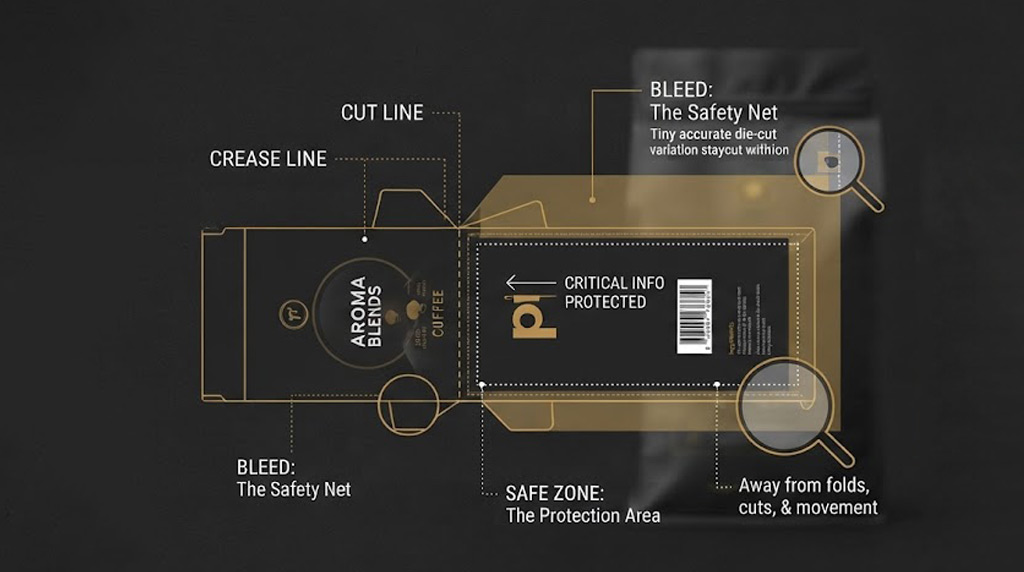
01 — Bleed: The Safety Net
Bleed is the area where the artwork extends beyond the final trim or cut line.
Its purpose is simple: to absorb normal cutting tolerances.
Without sufficient bleed, even a small variation during die-cutting can leave an unwanted white edge along the package.
Bleed is not part of the finished package.
It is a controlled allowance that gives the production process room to operate.
02 — Cut & Crease Lines: The Manufacturing Guide
Cut and crease lines define where the package will be cut, folded, or scored.
They are production references, not artwork boundaries.
The dieline tells the manufacturer how the package is physically constructed. Artwork must therefore be positioned in relation to the dieline, while also accounting for bleed, folds, seals, and other structural features.
A visually perfect design can still create production problems if these technical references are misunderstood or incorrectly prepared.
03 — Safe Zone: The Protection Area
The safe zone is the area inside the trim and away from folds, cuts, and other potential movement during production.
Critical information should remain safely within this area, including:
- Logos
- Product names
- Barcodes
- Ingredients and nutritional information
- Legal information
- Important brand elements
Keeping these elements away from vulnerable areas helps protect readability and prevents important information from being compromised during cutting, folding, or finishing.
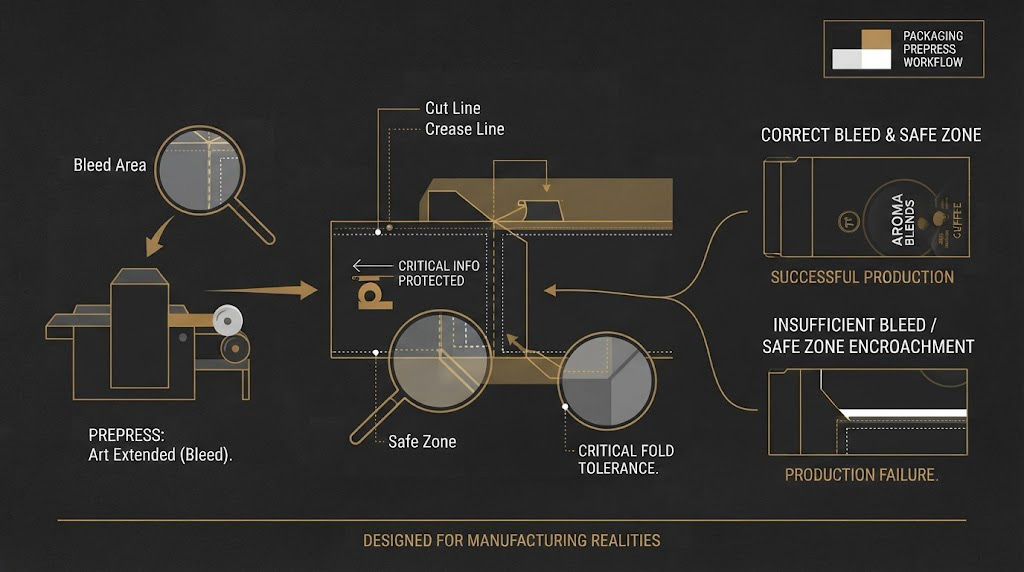
Why These Three Zones Matter
Packaging production is not perfectly static.
Materials move. Machines have tolerances. Cutting tools have limits. Folding and converting introduce additional variables.
The role of prepress is to anticipate these realities before the artwork reaches production.
A production-ready file is therefore more than a beautiful design.
It is artwork that has been prepared to survive the manufacturing process.
Design attracts attention.
Prepress protects the investment.
When bleed, dielines, and safe zones are correctly engineered, the distance between the approved artwork and the finished package becomes much more predictable.
And that’s ultimately what production-ready packaging is about:
Designing for the final physical result — not just the screen.
Bleed, Crease & Safe Zone: The Physics Behind Every Successful Packaging Production
Most packaging failures don’t happen because of poor design.
They happen because the artwork wasn’t built for manufacturing.
A packaging file may look perfect on screen and still fail during production because printing, die-cutting, folding, and finishing are physical processes — each with its own tolerances and limitations.
Even a small shift during cutting or folding can expose unwanted white edges, affect important text, or compromise the appearance of the final package.
That’s why production-ready packaging artwork is built around three essential technical zones.
01 — Bleed: The Safety Net
Bleed is the area where the artwork extends beyond the final trim or cut line.
Its purpose is simple: to absorb normal cutting tolerances.
Without sufficient bleed, even a small variation during die-cutting can leave an unwanted white edge along the package.
Bleed is not part of the finished package.
It is a controlled allowance that gives the production process room to operate.
02 — Cut & Crease Lines: The Manufacturing Guide
Cut and crease lines define where the package will be cut, folded, or scored.
They are production references, not artwork boundaries.
The dieline tells the manufacturer how the package is physically constructed. Artwork must therefore be positioned in relation to the dieline, while also accounting for bleed, folds, seals, and other structural features.
A visually perfect design can still create production problems if these technical references are misunderstood or incorrectly prepared.
03 — Safe Zone: The Protection Area
The safe zone is the area inside the trim and away from folds, cuts, and other potential movement during production.
Critical information should remain safely within this area, including:
- Logos
- Product names
- Barcodes
- Ingredients and nutritional information
- Legal information
- Important brand elements
Keeping these elements away from vulnerable areas helps protect readability and prevents important information from being compromised during cutting, folding, or finishing.
Why These Three Zones Matter
Packaging production is not perfectly static.
Materials move. Machines have tolerances. Cutting tools have limits. Folding and converting introduce additional variables.
The role of prepress is to anticipate these realities before the artwork reaches production.
A production-ready file is therefore more than a beautiful design.
It is artwork that has been prepared to survive the manufacturing process.
Design attracts attention.
Prepress protects the investment.
When bleed, dielines, and safe zones are correctly engineered, the distance between the approved artwork and the finished package becomes much more predictable.
And that’s ultimately what production-ready packaging is about:
Designing for the final physical result — not just the screen.